Security Days March 7-9, 2018 Tokyo, Japan

Security Days March 7-9, 2018 Tokyo, Japan
Apricot 2018 APNIC45 February 25-28, 2018 Kathmandu, Nepal
Multiple vulnerabilities were found by NSFOCUS researchers in Schneider Pelco Sarix professional Cameras. These vulnerabilities included: CVE# Vulnerability Severity CVE-2018-7227 Information Disclosure Medium CVE-2018-7228 Admin Privilege Authentication Bypass High CVE-2018-7229 Admin Privilege Authentication Bypass High CVE-2018-7230 XML External Entity Vulnerability High CVE-2018-7231 Command Execution - ‘system.opkg.remove’ Critical CVE-2018-7232 Command Execution...
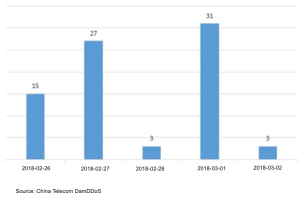
Recently, many domestic and foreign security companies and agencies issued warnings about the Memcached Distributed Reflection Denial of Service attack, which aroused the concern of all parties. According to our monitoring, the peak traffic for this attack has now reached 1.35T. On Feb. 27, Memcached's reflection DDoS attacks ranged from hundreds of...
At the beginning of 2018, jackson-databind was reported to contain another remote code execution (RCE) vulnerability (CVE-2017-17485) that affects versions 2.9.3 and earlier, 2.7.9.1 and earlier, and 2.8.10 and earlier. This vulnerability is caused by jackson-dababind's incomplete blacklist. An application that uses jackson-databind will become vulnerable when the enableDefaultTyping method...
A remote RCE vulnerability (CVE-2017-17562) was found in all GoAhead Web Server’s versions earlier than 3.6.5. The vulnerability is a result of initializing the environment of forked CGI scripts using untrusted HTTP request parameters, and will affect all users who have CGI support enabled with dynamically linked executables (CGI scripts)....