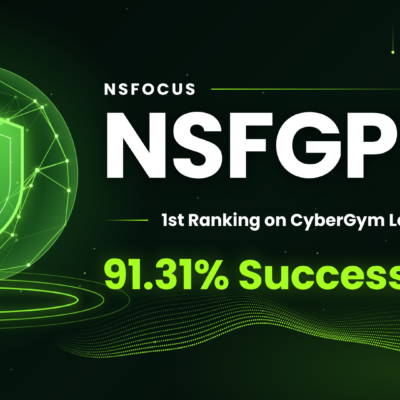
NSFOCUS NSFGPT Foundation Model (SecLLM-3.6-27B) just ranked first again globally on the CyberGym Model-Focused Leaderboard with a task success rate of 91.31%! This is a pure model leaderboard. Under CyberGym’s Model-Focused rules, models are evaluated strictly using a generic harness—without fixed stages, external tools, knowledge bases, or specialized agentic designs—purely...

Categoria: Blog
Apache HTTP Server Remote Code Execution Vulnerability (CVE-2026-119618) Advisory
Overview NSFOCUS CERT recently noted that Apache had released a security advisory announcing a fix for a remote code execution vulnerability (CVE-2026-119618) in Apache HTTP Server. Due to improper synchronization when accessing shared resources in the assign_headers() function of Apache HTTP Server's mod_http2 module, an unauthenticated attacker could trigger a...
OpenSSH/musl Password Authentication Bypass Vulnerability (CVE-2026-123158) Advisory
Overview Recently, NSFOCUS CERT monitored that OpenSSH released a security update fixing the OpenSSH/musl password authentication bypass vulnerability (CVE-2026-123158). Because crypt() in musl libc returns "*" upon failure, when the target account's password field is "*" and other accounts using password hashes exist on the system while SSH password authentication...
Adversarial | Intelligent | Evolving: How NSFOCUS Smart Security 4.0 Redefines its Security Paradigm in the AI Era
SANTA CLARA, Calif., November 11, 2026 – NSFOCUS recently launched its Smart Security 4.0 strategy during the 2026 TechWorld Smart Security Conference held in Beijing, which seeks to rebuild security capabilities around an intelligence-native foundation, continuously evolve to counter emerging threats, improve operational efficiency through autonomous operations, and strengthen security and resilience...
Linux Kernel IPv4 TCP Use-After-Free Vulnerability (CVE-2026-98432) Advisory
Overview Recently, NSFOCUS CERT monitored that Linux released a security update to fix the Linux Kernel IPv4 TCP use-after-free vulnerability (CVE-2026-98432). Due to a race condition issue in the Linux kernel IPv4 network subsystem when concurrently handling TCP connection requests or socket migration, an unauthenticated attacker can trigger a use-after-free...
AI Security Incident Case: Agents Bypassed Vercel Sandbox Isolation to Exfiltrate Data
Overview On October 12, 2026, AI security firm AIR Security disclosed a network isolation bypass technique for the Vercel Sandbox, dubbed "VerCellBreak." An AI agent controlled by an attacker can smuggle private keys out of the sandbox by leveraging a standard feature in the TLS certificate chain validation process, without...