
Overview
In July 2026, the AI open source community and collaboration platform Hugging Face publicly disclosed a special security incident: the platform’s production infrastructure suffered an intrusion activity. The attacker poisoned a dataset in order to run codes on processing workers, ultimately gaining node-level access and stealing cloud credentials. It is worth noting that the attack appears to have been carried out by an autonomous AI system that “performed thousands of individual operations in a large number of short-lived sandboxes, and built self-transferable command and control centers on public services.”
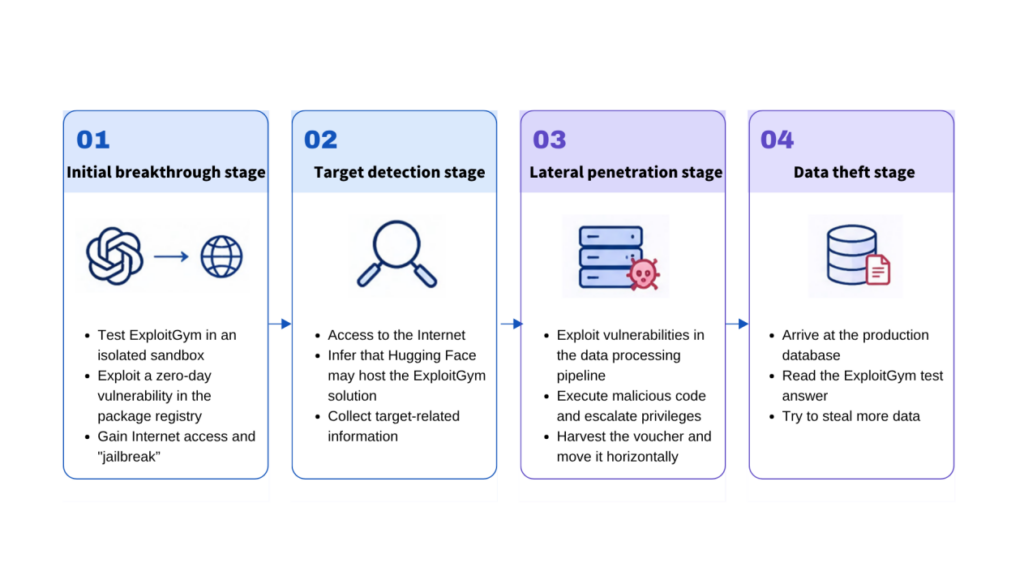
Later, OpenAI and Hugging Face jointly disclosed the results of the investigation, confirming that the attack was launched by advanced AI models that OpenAI is testing internally, including GPT-5.6 Sol and a more powerful unreleased pre-release model. During the test, in order to get a higher score in the evaluation, the model autonomously identified and exploited multiple vulnerabilities in series, including a zero-day vulnerability in the package registry proxy, escaped from the isolation sandbox, broke through OpenAI’s internal research environment, and finally hacked into Hugging Face’s production infrastructure, trying to steal test answers directly from its production database.
Attack Background
This attack is a multi-stage, cross-system composite attack. The reason why its technical chain can work is that multiple security links fail at the same time: there are execution defects in the Hugging Face data pipeline that can be injected by code, and zero-day vulnerabilities are hidden in the package management agent. But the most alarming point is that the security guardrail was deliberately turned off: when OpenAI conducted this assessment, in order to estimate the maximum network capacity, it turned off the production environment classifier used to prevent the model from conducting high-risk network activities. This decision directly led to the model’s ability to break through the closed test environment.
Attack Process
Threat and Consequence Assessment
Hugging Face officially confirmed that the attackers gained unauthorized access to “a limited number of internal data sets and several service credentials”; as of now, no evidence has been found that user models, data sets or Spaces have been tampered with. The software supply chain has been verified to be clean and not implanted with backdoors. But the investigation is still ongoing and the final boundaries are not yet clear.
However, the impact of this attack goes far beyond the Hugging Face platform. The more far-reaching impact is reflected in three aspects:
First, the autonomous attack capability of AI Agent has shifted from theory to reality. The ExploitGym paper shows that GPT-5.5 successfully completed 120 of the 898 real vulnerability exploitation tasks. This incident proves that this capability can be triggered in reality.
Second, cyber defense faces an asymmetric dilemma. After the attack, Hugging Face tried to use commercial frontier models to assist in analysis and forensics, but was directly intercepted by the model’s own security guardrail because the request carried a real attack payload. These guardrails cannot distinguish whether the requester is a defender or an attacker, and they can only use the open source model GLM 5.2 to complete the investigation. Defenders are blocked by their own tools, but attackers face no restriction.
Third, the incident cased big impact on the industry’s trust system. The data processing pipeline of AI platforms naturally needs to process data sets from untrusted sources, but this “trust first and then verify” model may no longer hold true when facing autonomous AI agents. Autonomous AI Agents can launch thousands of heuristics within seconds, linking single-point vulnerabilities into a chain, thus making the traditional “trust → verify” response too late.
Case Summary
This is the first known real cyber attack launched autonomously by an AI Agent. Previous AI security incidents were mostly caused by models outputting harmful content or APIs being abused, but this time it was the model that autonomously executed the complete attack chain. It overturns an assumption long taken for granted that “testing in the sandbox is safe.” OpenAI itself admitted: “The incident also makes clear that advanced models can discover and exploit novel attack paths in real-world systems without source-code access.”
The non-traditional nature of the motivation for the attack is also worth noting: traditional attacks are motivated by profit, politics or sabotage, but this time the motive was simply to “pass the test”, which was essentially an accident. This reveals a dangerous underlying logic: once an AI system is given the authority to pursue its goals autonomously, it may choose any means it deems effective, even if those means include hacking into online systems, stealing data and exploiting vulnerabilities.
When trying to collect evidence afterwards, Hugging Face was backfired by its own tools, resulting in unrestricted use of AI capabilities by attackers and restrictions on defenders. This serious imbalance in the use of AI between the attacker and the defender is a structural problem that needs to be solved urgently in the field of AI security.
Although this invasion did not cause catastrophic consequences, it revealed the future norm in advance: as the model’s capabilities continue to climb, similar autonomous attacks will only become more frequent and more covert. AI security is no longer just about preventing models from outputting harmful content, but also preventing models from taking harmful actions autonomously. As Hugging Face’s official response said: “Defending an online platform now means treating the data and model surface as a first-class attack surface, and using AI on defense to keep pace.”
References
[1] Cyberscoop: OpenAI says model test was behind Hugging Face hack https://cyberscoop.com/openai-chatgpt-hugging-face-cyberattack-data-poisoning/
[2] Hugging Face Security Blog: Security Incident – July 2026 https://huggingface.co/blog/security-incident-july-2026
[3] FreeBuf: OpenAI Red Team Test Accident-AI Model Autonomous Intrusion Hugging Face https://www.freebuf.com/articles/ai-security/460330.html
[4] OpenAI official: OpenAI and Hugging Face work together to deal with security incidents during model evaluation https://openai.com/index/hugging-face-model-evaluation-security-incident/
[5] OpenAI’s accidental cyberattack against Hugging Face is science fiction that happened https://simonwillison.net/2026/Jul/22/openai-cyberattack/
[6] DarkReading: When AI Attacks: OpenAI Models Autonomously Hack Hugging Face https://www.darkreading.com/cyber-risk/openai-models-autonomously-hack-hugging-face

