Regional APT Threat Situation In June 2026, the global threat hunting system of Fuying Lab detected a total of 28 APT attack activities. These activities were primarily concentrated in regions including East Asia, South Asia, Eastern Europe, South America, and Central Asia as shown in the figure below. Regarding the...

Categoria: Blog
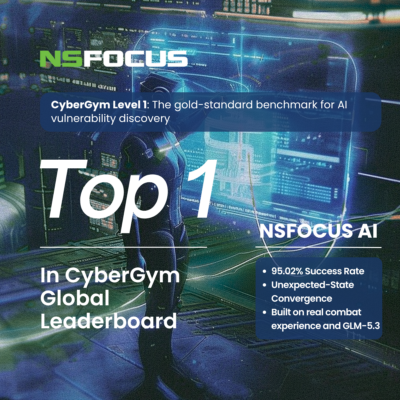
95.02% Success Rate! NSFOCUS AI Tops the CyberGym Global Leaderboard
In the CyberGym Level 1 global leaderboard, an authoritative benchmark for cybersecurity large models, NSFOCUS AI, NSFOCUS’s self-developed intelligent security agent captured the top global ranking in this round with a 95.02% vulnerability-reproduction success rate. Built on Zhipu’s GLM-5.3 large language model, NSFOCUS AI distills NSFOCUS’s accumulated offensive-and-defensive expertise into...
Global Recognition: NSFOCUS Listed in Gartner® Market Guide for Cloud Web Application and API Protection for Three Consecutive Years
SANTA CLARA, Calif., August 28, 2026 – Gartner®, a global business and technology insight firm, recently published the Market Guide for Cloud Web Application and API Protection, in which NSFOCUS has been listed for the third consecutive year through its Web Application Firewall (NSFOCUS WAF). For NSFOCUS, this repeated inclusion reflects...
O que são LLMs? Entenda como funcionam
Os LLMs estão por trás de boa parte das ferramentas de inteligência artificial que escrevem textos, resumem documentos, respondem perguntas, analisam informações e auxiliam profissionais em tarefas criativas ou técnicas. Ao longo do artigo abaixo, você entenderá o que é LLM, como esses modelos são treinados, de que maneira produzem...
NSFOCUS Named to the 2026 IDC China AI Top 50
On August 18, the "2026 IDC China Artificial Intelligence and Data Summit," hosted by IDC, was grandly held in Beijing, bringing together numerous industry elites and technology leaders. With its solid technical foundation and mature, proven industry solutions in AI security, NSFOCUS was named to the "2026 IDC China AI...
AI Security Incident Case: Encrypted Reasoning Blocks of Proprietary LLMs Can Be Stolen via Cross-Model Replay
Overview On August 10, 2026, MATS Research, the ELLIS Institute Tübingen, the Max Planck Institute for Intelligent Systems, and other institutions jointly published the paper Stealing Reasoning Traces from Proprietary LLM APIs. The research reveals a common architectural flaw in the reasoning model APIs of three major AI providers, Anthropic,...