
On November 18, at the Frost & Sullivan 2026 Best Practices Recognition ceremony, NSFOCUS received the 2026 China AI Security Technology Innovation Leadership recognition, marking another international accolade following its 2026 Global Anti-DDoS Competitive Strategy Leadership award from Frost & Sullivan.
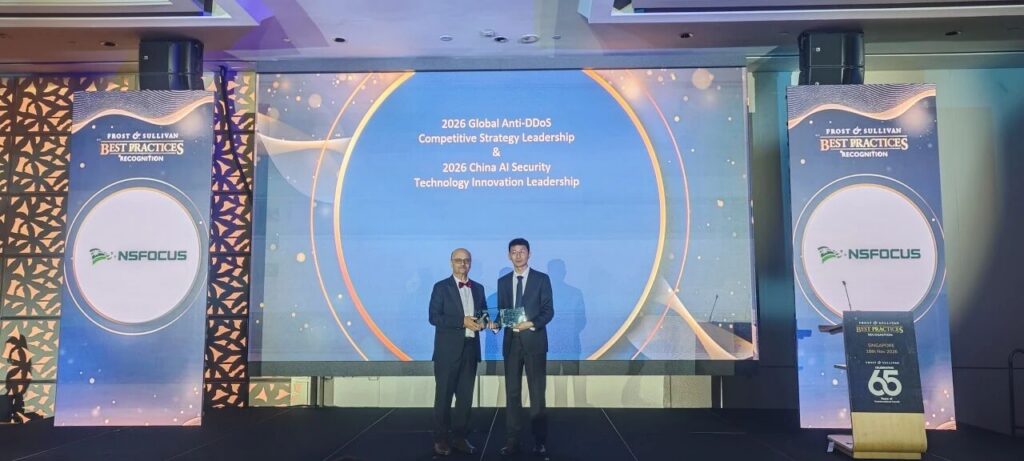
The two accolades attest to NSFOCUS’s achievements in AI security innovation and underscore the tangible progress of its ongoing global expansion strategy.

China AI Security Technology Innovation Leadership
Frost & Sullivan’s assessment highlights a shift in NSFOCUS’s approach: rather than adding an AI threat detection layer to existing systems, the company has redesigned its architecture around four risk domains—large language models (LLMs), AI agents, AI-generated content, and enterprise AI assets—integrating assessment, protection, data security, and asset management into a unified framework.
NSFAIS Security Capability Matrix
The NSFAIS (AI Application Security) solution comprises five products, each addressing a distinct capability domain:
| Product | Core Capabilities |
| AI Risk Assessment System (AI-SCAN) | AI asset discovery and security compliance assessment |
| AI Detection and Response System (AI-DR) | Detection and response for AI applications and interactions |
| AI Security Guardrails (AI-GR) | Governance and protection of AI-generated content and data |
| AI Security Gateway (AI-UTM) | Authentication and security controls for AI access and invocation, and coordinated protection across products |
| AI Red Team Assessment System (AI-RT) | Adversarial attack simulation, validation of protection effectiveness, and closed-loop security risk management |
The five products can be deployed independently or orchestrated together, supporting a phased approach to enterprise AI security: starting with asset and compliance assessments, followed by detection and response, then content and data governance and centralized management, with red teaming integrated throughout the lifecycle.
The products can also integrate with customers’ existing application protection, exposure management, and security operations systems, eliminating the need to build a separate platform.
Three-Stage Protection Framework
Underpinning the product suite is a three-stage protection framework: Radar Sweep, Real-Time Shield, and Continuous Hardening.
Radar Sweep discovers AI assets and invocation paths, producing an asset map and a risk profile; Real-Time Shield protects the AI interaction chain, covering user inputs, assembled context, tool-call parameters, and model outputs;Continuous Hardening feeds blocked threat samples back into policy and baseline refinement, combined with periodic retesting, to keep defenses aligned with evolving attack techniques.
All three stages share NSFGPT, NSFOCUS’s security large language model, as their foundation for security reasoning, threat analysis, and response recommendations, with a primary focus on threat assessment: translating alerts into understandable risk categories and response actions into work orders and recommendations on responsibility assignment.
Extending Protection to AI Agents
Traditional security controls monitor processes, connections, and network traffic, whereas AI agent behavior is characterized by a chain of input intent, tool calls, and resulting actions.
Once granted access to tools, AI agents can read and write files, query databases, send emails, and call external APIs, with risks present at every stage of the chain.
As AI agents often run in browsers, integrated development environments (IDEs), and desktop clients, some calls bypass enterprise network egress points, making it difficult for gateways to achieve full visibility.
NSFAIS extends detection to the endpoint, monitoring every prompt, tool call, and action and blocking malicious activity before it reaches the enterprise internal network, thereby protecting every endpoint hosting an AI agent or assistant.
Where to Start
Enterprises rarely build out their entire AI security infrastructure in one go.
In practice, a three-step approach is more common, and the sequence matters: first, identify assets and identities to create an AI asset map; second, enforce identity-based protection at the interaction and execution stages; third, establish centralized management and continuously refine policies and permissions.
Global Anti-DDoS Competitive Strategy Leadership Award
Flexible Network Integration and Unified Multi-Region Protection Operations
In its assessment report, Frost & Sullivan notes that flexible deployment and a consistent cross-region operational experience enabled by the platform together give the NSFOCUS anti-DDoS solution a competitive edge.
Customers can choose out-of-path or inline deployment based on their existing network topology, with support for coordinated on-premises protection and cloud-based traffic scrubbing (NSFOCUS Cloud DPS).
Cloud scrubbing can serve as the primary defense or as a supplementary measure when attack traffic exceeds on-premises mitigation capacity, ensuring business continuity.
For multi-region protection, the NSFOCUS traffic scrubbing service operations platform(NSFOCUS ADBOS) enables centralized management of scrubbing resources, protection policies, and attack activity across locations, providing cross-region visibility and coordinated incident response.
In multi-tenant environments, service operators can provision services, allocate resources, and generate customized reports and bills for tenants; tenants can view their protection status and adjust policies within their authorized permissions through a portal, improving the overall service experience while enhancing both security and business value.
Leveraging AI for More Accurate Attack Detection and More Efficient Security Operations
NSFOCUS integrates AI-assisted security operations into its anti-DDoS solution, prioritizing capabilities such as automated attack classification, multi-vector attack correlation analysis, intelligent mitigation recommendations, and attack incident summarization, while emphasizing explainable, evidence-based AI decision-making to advance intelligent DDoS mitigation operations.
At the device level, NSFOCUS embeds lightweight AI models into two appliances: its Network Traffic Analyzer (NTA) for detection and its Anti-DDoS System (ADS) for scrubbing. These models continuously learn normal business traffic patterns to establish dynamic traffic baselines and combine real-time traffic analysis with anomaly detection to intelligently detect and classify attack traffic, improving the identification of low-and-slow attacks, encrypted command-and-control (C&C) communications, and emerging DDoS attacks.
By integrating AI-powered detection into traffic monitoring and scrubbing, NSFOCUS helps customers identify abnormal traffic and sophisticated attacks more promptly, providing a reliable basis for targeted mitigation.
At the operations level, NSFOCUS uses ADBOS as its intelligent operations hub and tightly integrates NSFGPT, its security large language model (SecLLM), to deliver an AI operations assistant that supports attack incident assessment, mitigation policy recommendations, response guidance, effectiveness evaluation, knowledge-based Q&A, and report generation, helping security teams quickly gain situational awareness, optimize response decisions, reduce manual analysis workloads, and improve operational efficiency.
NSFOCUS also emphasizes explainability and controllability in AI decision-making, retaining the underlying analytical evidence alongside AI-generated assessments and mitigation recommendations so that operations teams can verify AI decisions and retain control over policy adjustments and implementation.
By combining real-time detection from device-level AI models with intelligent analysis from platform-level LLMs, NSFOCUS has established a coordinated AI-powered defense framework spanning attack identification, intelligent analysis, decision support, and ongoing operations, helping customers respond to attacks more efficiently, streamline security workflows, and achieve more precise, efficient, and controllable DDoS protection.
Both accolades reflect the same core measure of value: whether technology can be translated into systems that customers can put into effective, sustained use.
With NSFAIS at its core, NSFOCUS delivers defense in depth for AI systems themselves through a three-stage framework; its anti-DDoS solution connects scrubbing appliances, intelligent platforms, and operational services into an integrated defense chain.
Looking ahead, NSFOCUS will remain focused on customers’ real-world needs, continue advancing cutting-edge AI technologies, expand its international business, and work with global partners to safeguard the development of the digital economy.

