
I. Overview
In November 2026, CNCERT detected the widespread propagation of a new variant of the Cling botnet, which primarily targets Linux servers and IoT devices. The malware employs an innovative communication mechanism and exhibits a high degree of stealth. Its command-and-control (C&C) infrastructure is concealed among public STUN services, while commands are embedded in the STUN Transaction ID field. This allows command-and-control traffic to blend into large volumes of legitimate STUN exchanges, making it difficult for conventional monitoring methods to detect.
The Cling malware evolves rapidly and has appeared in multiple versions. The variant currently spreading has a relatively streamlined feature set: it removes modules for vulnerability-based propagation, proxying, and DDoS attacks, retaining only core capabilities such as command execution and program downloading and execution. It also fixes a flaw in earlier versions that caused the C&C server to return anomalous Transaction IDs, and uses the ChaCha20 algorithm to encrypt and store critical information, making the malware harder to identify. The attackers’ primary objective is not to launch DDoS attacks, but to maintain long-term control over compromised hosts and use them as launchpads for delivering other malware, posing a significant threat. From November 9 to November 20, 2026, CNCERT observed that the number of bots infected by this botnet and active on a daily basis peaked at 2,730, with a cumulative total of 5,600 infected devices. The main findings are presented below.
II. Malicious Sample Analysis
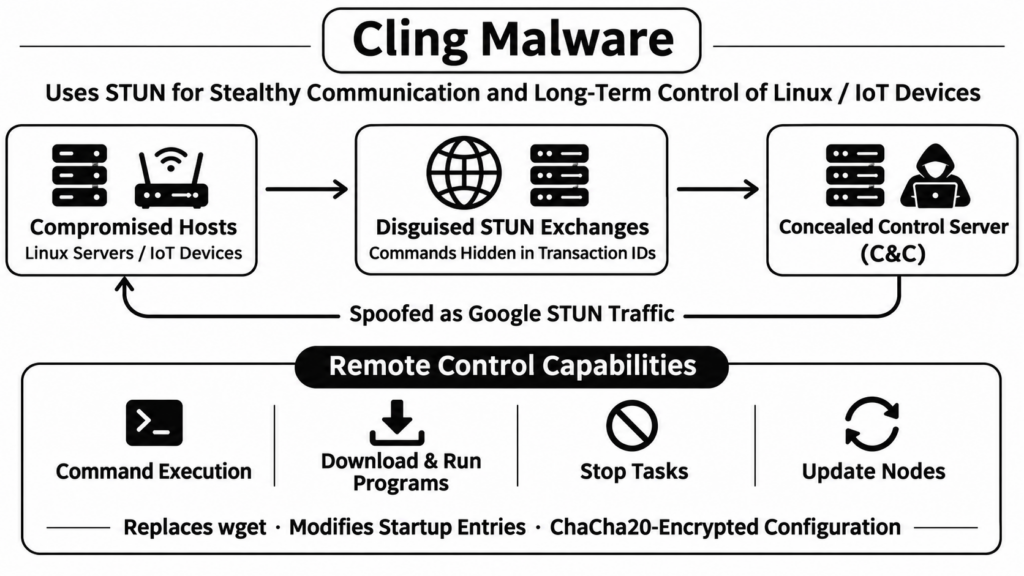
Figure 1. Cling Botnet
1. Propagation Methods
Research indicates that the new variant has had its vulnerability-exploitation module removed. The variant currently observed primarily spreads by exploiting CVE-2021-3539 4. Some vulnerabilities commonly exploited by earlier versions are listed below:
- CVE-2016-10372 (Eir D1000 router RCE)
- CVE-2023-41011 (FiberHome SR1041F router RCE)
- CVE-2014-8361 (Realtek SDK RCE)
- CVE-2023-26801 (LB-LINK router RCE)
- CVE-2024-3721 (TBK DVR RCE)
- CVE-2025-34037 (Linksys RCE)
- CVE-2016-20016 (MVPower CCTV DVR RCE)
2. Communication Mechanism
The Cling malware conceals its C&C infrastructure among public STUN services and embeds commands in the STUN Transaction ID field, giving it a high degree of flexibility and stealth. STUN is a standard protocol used to discover NAT-mapped addresses. Its message header contains a 12-byte Transaction ID field, which is normally expected to contain a random value. The new Cling variant hides command data in this field, making its control traffic almost indistinguishable from ordinary STUN exchanges.
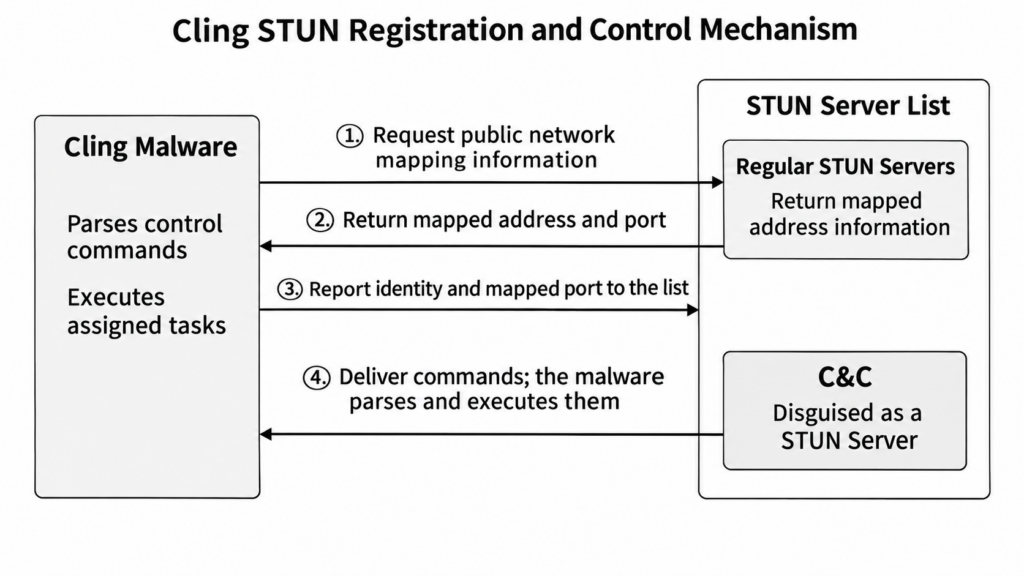
Figure 2. Cling Malware STUN Registration and Command-and-Control Mechanism
Impersonating STUN Services: The malware contains 13 ChaCha20-encrypted STUN server addresses: 12 public STUN servers and one attacker-controlled C&C server. The C&C server impersonates a STUN service and participates in the exchanges, effectively concealing itself among legitimate services.
Obtaining the NAT-Mapped Port: The malware periodically sends standard STUN Binding Requests to all 13 servers. Legitimate STUN servers respond normally, allowing the malware to discover its public-facing mapped port behind the NAT. This port serves as the entry point for receiving subsequent commands.
Sending Custom Registration Messages: The malware then sends custom registration messages that do not conform to the STUN specification to all servers. These messages carry the mapped port and an infection tag. Legitimate STUN servers discard the malformed messages in accordance with the protocol, while the compromised C&C server receives and records them, thereby learning the bot’s mapped port and infection tag.
Concealing Command Data: The C&C server subsequently sends commands to the mapped port. The commands are concealed in the Transaction ID field of STUN packets: the first 2 bytes serve as an identification marker, while the remaining 10 bytes contain encrypted task parameters. Since Transaction IDs are normally random values, the command data appears consistent with legitimate responses.
Spoofing the Source: When issuing commands, the C&C server spoofs its source address as a Google STUN server, making the traffic appear to defenders as ordinary traffic from a globally recognized STUN service.
3. Core Capabilities
The captured malware supports four types of remote commands. These commands allow it to manage tasks and deploy additional programs as needed:
Command Execution: The malware connects to a specified server, retrieves and decrypts commands, and then passes them to the operating system for execution.
Program Deployment: A command provides a task ID and a download server address. The malware first terminates any existing task with the same ID, then downloads the new program, grants it execution permissions, and launches it. This capability allows the malware to serve as a delivery channel for other malicious software.
Task Termination: The malware terminates previously downloaded and launched child processes by task ID.
Node Update: The malware replaces a node in its list with a new address supplied in a command, allowing subsequent reporting destinations to be adjusted according to the attacker’s instructions.
4. Persistence and Evasion
Configuration Encryption: The new variant uses ChaCha20 to conceal embedded configurations, command-and-control parameters, and remote commands, further enhancing its stealth.
Replacement of System Utilities: The malware replaces the commonly used download utility wget.
Startup Persistence: It also appends execution entries to existing files such as /etc/inittab, /etc/init.d/rcS, and /etc/rc.d/rc.boot to ensure that it runs automatically at system startup.
Single-Instance Protection: The malware listens on port 58346 and binds to a local address to prevent multiple instances from running. This technique is commonly used by traditional botnet families such as Mirai. It also attempts to write -1000 to /proc/self/oom_score_adj, reducing the likelihood of being terminated when the system runs low on memory.
5. Version Updates
The Cling malware evolves rapidly and has appeared in multiple versions. The variant currently spreading has the following key characteristics:
Stronger Encryption: Some earlier versions did not encrypt critical information. All samples of the version captured in this campaign use ChaCha20 to conceal embedded configuration data, improving stealth.
Streamlined Functionality: Built-in scanning, vulnerability exploitation, proxy, and DDoS capabilities have been removed. Command execution and program downloading and execution are retained, shifting the malware’s focus toward the sustained exploitation of compromised hosts.
Improved Stealth: The flaw in earlier versions, in which the Transaction ID returned by the actual C&C server differed from the data returned by STUN servers, has been fixed. This makes the impersonation harder to detect and further improves the stealth of its communications.
C&C Infrastructure Changes: The C&C server has been changed to a new IP address.
III. Infection Scale
Monitoring and analysis indicate that from November 9 to November 20, 2026, the Cling botnet infected approximately 5,600 devices in mainland China. The number of infected bots active on a daily basis in mainland China peaked at 2,730. The infection trend is shown below:
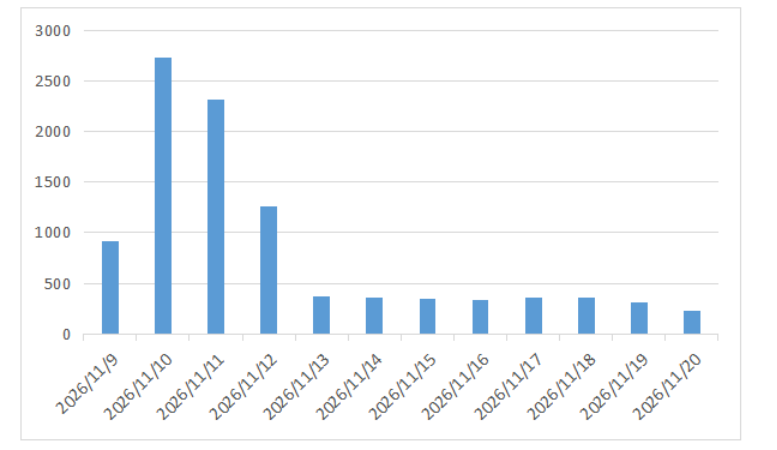
Figure 3. Number of Infected Endpoints in Mainland China
IV. Conclusion
The Cling malware uses STUN services to register infected hosts and conceals commands in the Transaction ID field, disguising its command-and-control communications as ordinary protocol exchanges. This stealthy communication design is relatively uncommon among existing botnets. Its capabilities focus on remote execution, program deployment, and persistent operation, reflecting the attackers’ emphasis on long-term use of compromised hosts. The replacement of system utilities, persistence through startup entries, and process-hiding techniques make investigation and cleanup more difficult. The malware poses a real threat to the ecosystems of Linux servers and IoT devices and warrants continuous monitoring and heightened vigilance.
V. Mitigation Recommendations
Internet users and network operators are advised to strengthen their risk awareness and security measures to avoid unnecessary financial losses. The main recommendations are as follows:
- Review and maintain an up-to-date asset inventory, and remediate relevant system vulnerabilities, including both previously known and newly disclosed vulnerabilities. IoT device firmware should also be updated.
- Strengthen password security and avoid weak passwords. Passwords should contain uppercase and lowercase letters, numbers, and symbols. Passwords of at least 16 characters are recommended. Use unique passwords for different devices and change them regularly.
- Install endpoint protection software and perform regular full-system scans. Pay particular attention to suspicious processes, unusual outbound connections, and the indicators listed in this alert.
- Enhance monitoring for anomalous STUN traffic. In particular, inspect periodic registration traffic sent to multiple STUN nodes over UDP port 3478, as well as Transaction IDs that are non-random and follow a fixed structure.
- Conduct targeted inspections on host systems, focusing on startup entries related to .alya in locations such as /etc/inittab and /etc/rc.d/rc.boot.
- If a host is found to be infected, immediately verify the extent of compromise and the intrusion vector, isolate and remediate the affected host, and promptly report the incident to the competent local authority.
VI. Related Indicators of Compromise (IoCs)
Sample MD5 Hashes:
- 84ced85e53bc326f8b11115ae4bc24a7
- 65d94c9dddea41ef4690f193fbc54ec3
- 92533318fb6f0365eefd25090e7df146
- be719987bf96fa16ac98b7c2a280cc74
- e37b94dfcaa56924142c344edcb3652a
- 79de772daa218e25a812ecbedca08476
- 606f2fee6fa4b3ca556187c9ee709f3d
- b672e3238742504faa93d5a7cb8d0ea0
- dc11a0e68e5235e36480ddf14f08afbe
- 76021af2d82cade790dd87d3af0f80c9
- 16ef618bf21a3322c6793be87d553f08
- fe35c5b3cfa118fdf8e1afb9a134e084
Download URLs:
- http[:]//202.110.70.60:800/alya.x86
- http[:]//202.110.70.60:800/alya.mipsel
- http[:]//202.110.70.60:800/alya.arc
- http[:]//202.110.70.60:800/alya.mips
- http[:]//202.110.70.60:800/alya.x86_64
- http[:]//202.110.70.60:800/alya.m68k
- http[:]//202.110.70.60:800/alya.i486
- http[:]//202.110.70.60:800/alya.sparc
- http[:]//202.110.70.60:800/alya.powerpc
- http[:]//58.211.144.243:800/alya.mipsel
- http[:]//58.211.144.243:800/alya.mips
- http[:]//58.211.144.243:800/alya.x86_64
- http[:]//58.211.144.243:800/alya.i486
- http[:]//58.211.144.243:800/alya.arc
- http[:]//58.211.144.243:800/alya.powerpc
- http[:]//58.211.144.243:800/alya.m68k
- http[:]//118.45.196.225:800
- http[:]//120.193.219.210:800
C&C Server:
- 209.99.188[.]119

