
Overview
Recently, NSFOCUS CERT monitored that GitLab released a security update to fix the GitLab Remote Code Execution Vulnerability (CVE-2026-97229). Due to insufficient validation of regular expressions in GitLab’s CI/CD configuration, unauthenticated attackers can construct special regular expressions within the CI/CD configuration to trigger an integer overflow during compilation, thereby executing arbitrary code with the privileges of the Git account. The CVSS score is 10.0. Currently, vulnerability details and PoC have been made public; relevant users are advised to take protective measures as soon as possible.
GitLab is an open-source repository management system project developed by GitLab Inc., using Git as a code management tool to access public or private projects via a web interface.
Reference Link: https://docs.gitlab.com/releases/patches/patch-release-gitlab-19-4-2-released/
Scope of Impact
Affected versions
- 19.2.0 <= GitLab CE/EE < 19.2.8
- 19.3.0 <= GitLab CE/EE < 19.3.5
- 19.4.0 <= GitLab CE/EE < 19.4.2
Note: Attackers need access to the CI Lint interface of a public project and have write permissions.
Unaffected versions
- GitLab CE/EE >= 19.2.8
- GitLab CE/EE >= 19.3.4
- GitLab CE/EE >= 19.4.2
Vulnerability Detection
Relevant users can determine whether the current application is at risk through version detection methods.
1. Use the following command to check the currently used GitLab version:
| cat /opt/gitlab/embedded/service/gitlab-rails/VERSION |

2. After logging into GitLab, enter <GitLab Address Instance>/help in the browser to view the current GitLab version information:
- GitLab Community Edition v19.2.6
- Check the current instance configuration
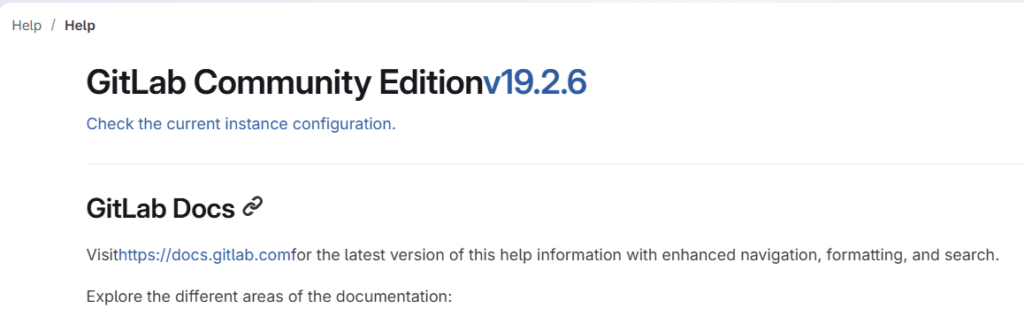
If the current version falls within the affected range, there may be security risks.
Mitigation
Official Upgrade
The vendor has released a new version to fix this vulnerability. Affected users are advised to upgrade their versions as soon as possible for protection.
Download Link: https://about.gitlab.com/update
Other Protective Measures
If relevant users are temporarily unable to perform an upgrade, they can restrict access to the system based on actual business circumstances.
Statement
This advisory is only used to describe a potential risk. NSFOCUS does not provide any commitment or promise on this advisory. NSFOCUS and the author will not bear any liability for any direct and/or indirect consequences and losses caused by transmitting and/or using this advisory. NSFOCUS reserves all the rights to modify and interpret this advisory. Please include this statement paragraph when reproducing or transferring this advisory. Do not modify this advisory, add/delete any information to/from it, or use this advisory for commercial purposes without permission from NSFOCUS.
About NSFOCUS
NSFOCUS, a pioneering leader in cybersecurity, is dedicated to safeguarding telecommunications, Internet service providers, hosting providers, and enterprises from sophisticated cyberattacks.
Founded in 2000, NSFOCUS operates globally with over 3000 employees at two headquarters in Beijing, China, and Santa Clara, CA, USA, and over 50 offices worldwide. It has a proven track record of protecting over 25% of the Fortune Global 500 companies, including four of the five largest banks and six of the world’s top ten telecommunications companies.
Leveraging technical prowess and innovation, NSFOCUS delivers a comprehensive suite of security solutions, including the Intelligent Security Operations Platform (ISOP) for modern SOC, DDoS Protection, Continuous Threat Exposure Management (CTEM) Service and Web Application and API Protection (WAAP). All the solutions and services are augmented by the Security Large Language Model (SecLLM), ML, patented algorithms and other cutting-edge research achievements developed by NSFOCUS.

