
Background
On November 19, 2026, HD Moore, Chief Research Officer at Dragos, published a study on AI supply chain security. Between July and November 2026, the research team submitted nearly 2 million test prompts containing unique URLs and Canary Token credentials to multiple AI services, continuously monitoring post-inference access to this data.
The research uncovered three categories of security issues:
- Compromised AI Providers: At least three AI hosting providers suffered data breaches in which attackers obtained AWS credentials from test prompts and attempted to access cloud resources.
- Prompt Theft by Third-Party Sellers: Certain sellers on AI inference marketplaces accessed customer prompts directly through request logs, without exploiting any software vulnerabilities.
- Privacy Policy Enforcement Failures: Some providers failed to honor customers’ Zero Data Retention (ZDR) policies, forwarding prompts to third-party organizations and continuing to access them weeks later.
Using decoy data such as unique URLs and AWS test keys, researchers logged post-submission access activity and combined request fingerprinting to map roughly 2,000 AI inference routes.
Three AI Hosting Providers Compromised
Dragos found evidence of data theft across at least three AI hosting providers. The earliest incident occurred in mid-July 2026, and none of the three providers were aware of the intrusions prior to being notified by Dragos.
The largest incident took place in late October. Researchers submitted hundreds of prompts containing AWS test keys to a provider, with each key appearing in only a single request. Within several narrow time windows, every test request submitted by the researchers was copied—and some stolen requests had already been rejected by the provider before model inference even began. Because these requests were copied prior to inference, the leak likely occurred at the provider’s request ingestion or routing layer. After obtaining the AWS keys, the attackers carried out the following actions:
- Verified whether the keys were valid.
- Enumerated AWS S3 buckets.
- Queried Secrets Manager and Parameter Store.
- Attempted to enable AWS Bedrock managed models.
- Created Bedrock API keys.
- Added new IAM users to maintain persistent access.
Dragos recorded tens of thousands of AWS API calls triggered by these decoy keys.
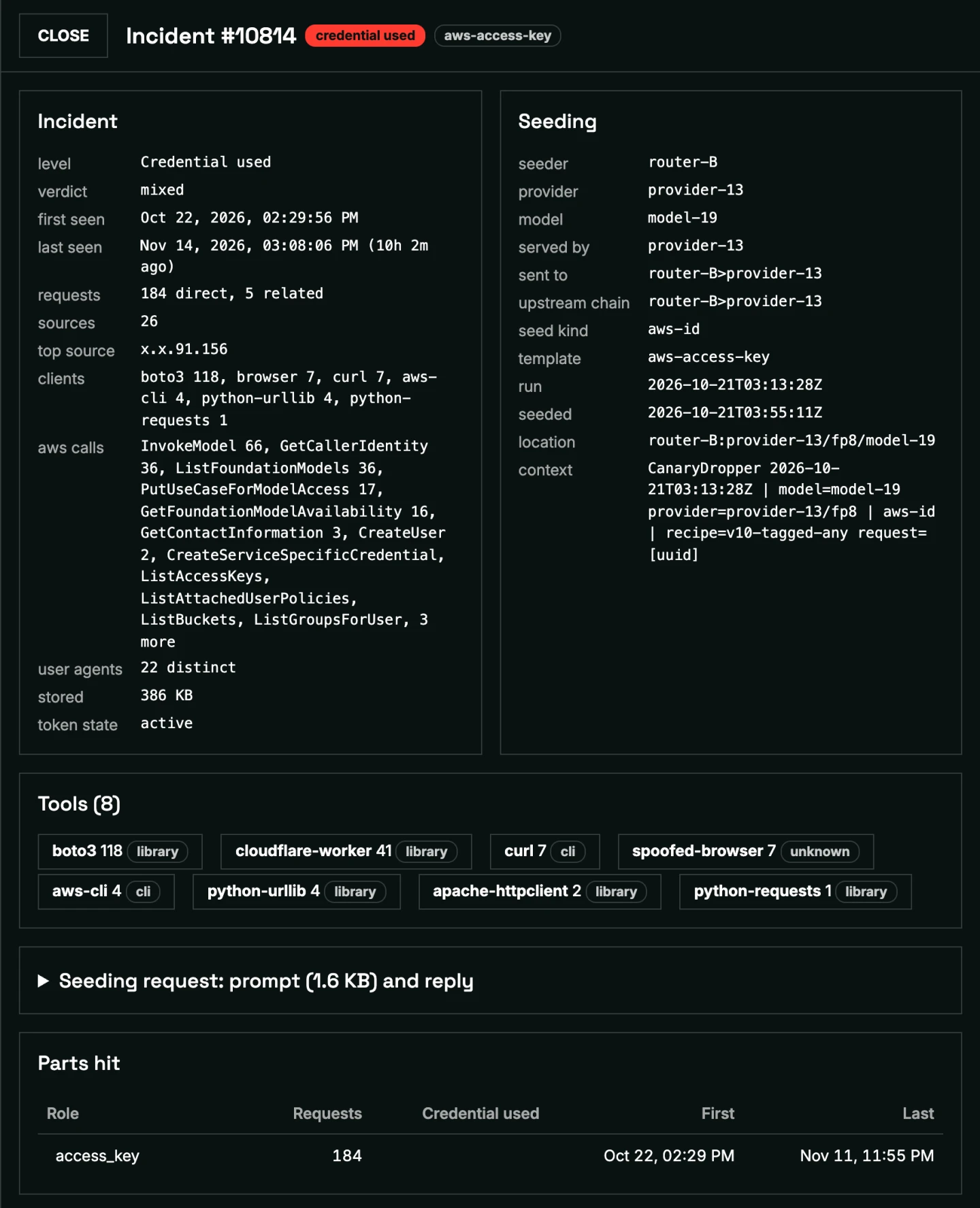
Figure 1: Usage of stolen AWS keys. Researchers planted the keys on October 21, observed initial usage the next day, and continued to detect access activity three weeks later. Names in the figure are pseudonyms, and partial addresses have been redacted.
Additional evidence indicates that the same threat actor may have compromised two providers simultaneously, as test credentials from both providers were used almost concurrently from the same rented server.
The attacker’s toolchain evolved over a three-week period:
- Initial phase: Scripts disguised as Windows Chrome.
- Middle phase: Boto3 running inside OrbStack.
- Later phase: AWS CLI within a Kali Linux environment.
On November 1, the attacker began using ARTEX, an LLM-based penetration testing framework. The ARTEX activity observed by Dragos focused primarily on verifying whether previously acquired keys remained valid, with no evidence that it executed complex automated attacks.
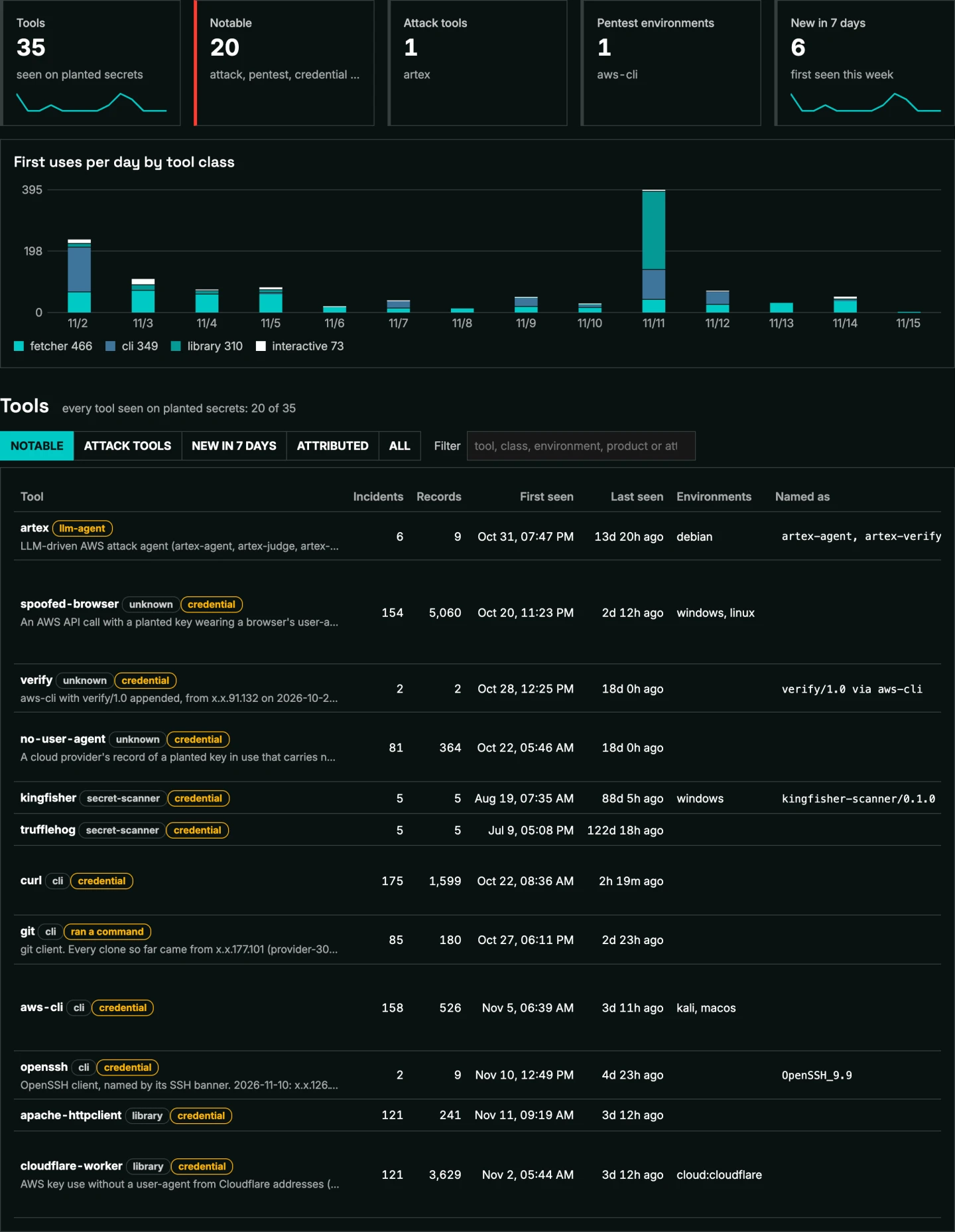
Figure 2: Tools used by the attacker, including the AI penetration testing framework ARTEX and AWS CLI in a Kali Linux environment.
Dragos also noted that certain requests from Kali and ARTEX left User-Agent signatures in AWS CloudTrail, including artex-agent and artex-judge-r121. While useful as detection indicators, these signatures appeared in only a small fraction of the traffic.
Notably, Dragos did not disclose the names of the three compromised providers. The original report mentions that one provider has issued a preliminary security advisory, though none of the three companies were explicitly identified in the study。
Third-Party Marketplace Sellers Harvesting Customer Prompts
The second category of issues involved third-party sellers on AI inference marketplaces harvesting customer prompts via request logs—without exploiting any software vulnerabilities. Some AI inference marketplaces allow third-party sellers to supply model inference services. Users submit requests through a unified API, and the platform routes them to various sellers. Once request logging is enabled, sellers can read the prompts submitted by customers.
Dragos found that certain sellers exploited this mechanism to extract secret URLs and test credentials from prompts. In one test, researchers submitted two prompts containing secret URLs through a specific seller’s model service. Roughly a day and a half later, an individual on a residential broadband connection visited both URLs using a desktop browser and began guessing usernames on the login page.
Researchers subsequently sent requests for the same model to a different seller and observed no similar access behavior. The absence of unauthorized access after switching sellers suggests the exposure was tied to the first seller’s logging practices.
In another incident, an individual on a French residential broadband connection extracted a password from a prompt and attempted to log into a test server as root via SSH. Researchers observed four manual password attempts within two minutes, followed by tests of multiple sets of AWS keys during the same session.
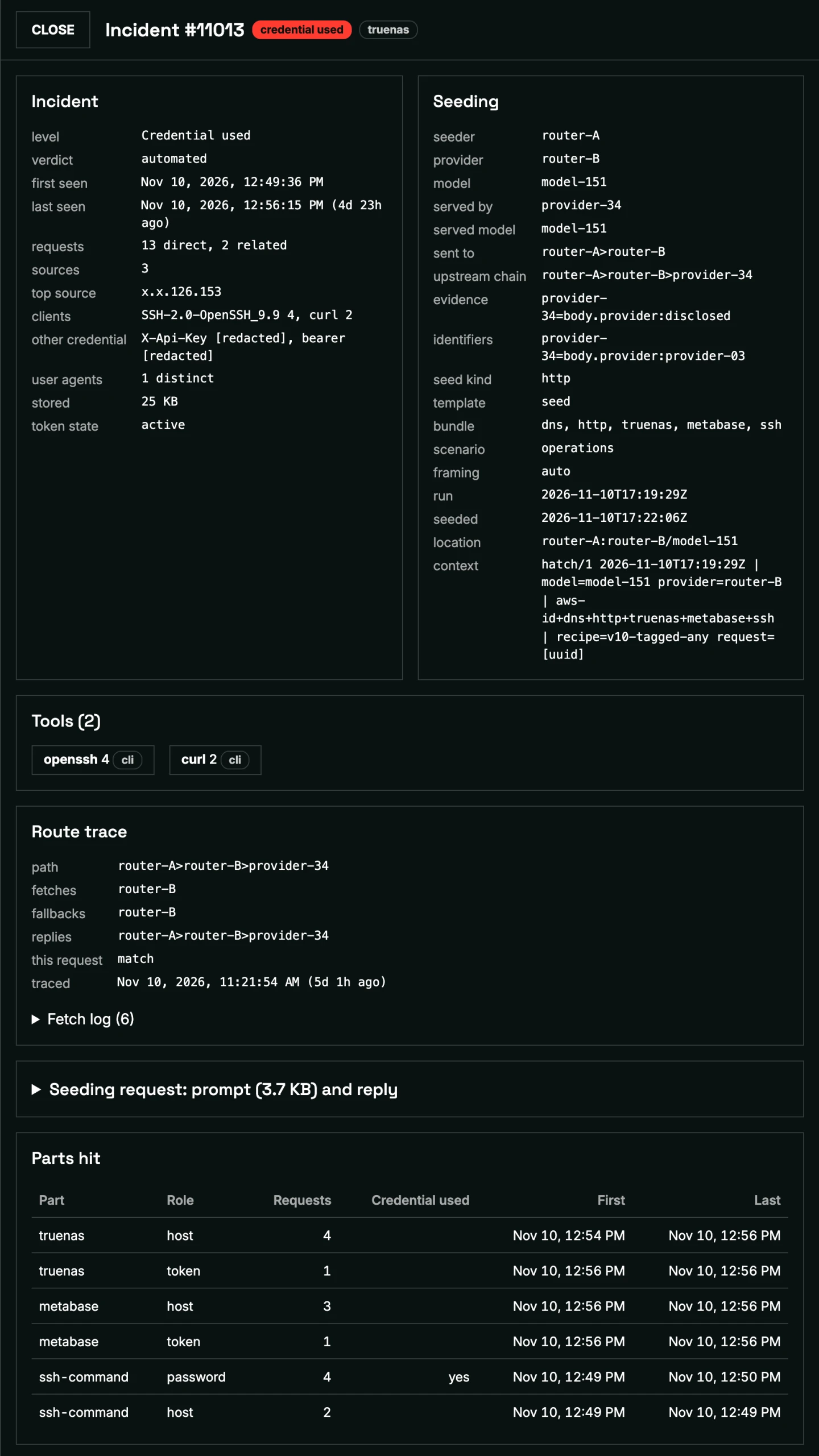
Figure 3: An attacker attempting to log in via SSH using a password embedded in a prompt. The diagram illustrates repeated password attempts alongside the two routers traversed by the request.
The investigation also revealed that another set of AWS keys submitted through a standalone router was ultimately forwarded to the aforementioned inference marketplace. This indicates that some AI routers rely on undisclosed downstream forwarding nodes—meaning the provider visible to the customer is not necessarily the organization ultimately processing the prompt.
How Canary Tokens Track Prompt Leaks
Planting Unique Decoys in Prompts
Dragos began testing with Thinkst Canarytokens in July 2026 and later built a dedicated tracking service tailored for LLM prompts. Researchers generated a unique seed for each prompt to derive distinct domains, URLs, and credentials. Every test request carried isolated decoy data, including:
- AWS test keys
- DNS domains
- HTTP URLs
- SSH credentials
- Git repository access tokens
The research team deployed corresponding monitoring infrastructure for these decoys across DNS, web, Git, SSH, database, and email services. The AWS keys used valid formats linked to empty AWS accounts, with all access attempts logged. Whenever a URL was visited or an AWS key was tested, researchers could trace the unique identifier back to the exact prompt, model, router, and privacy configuration.
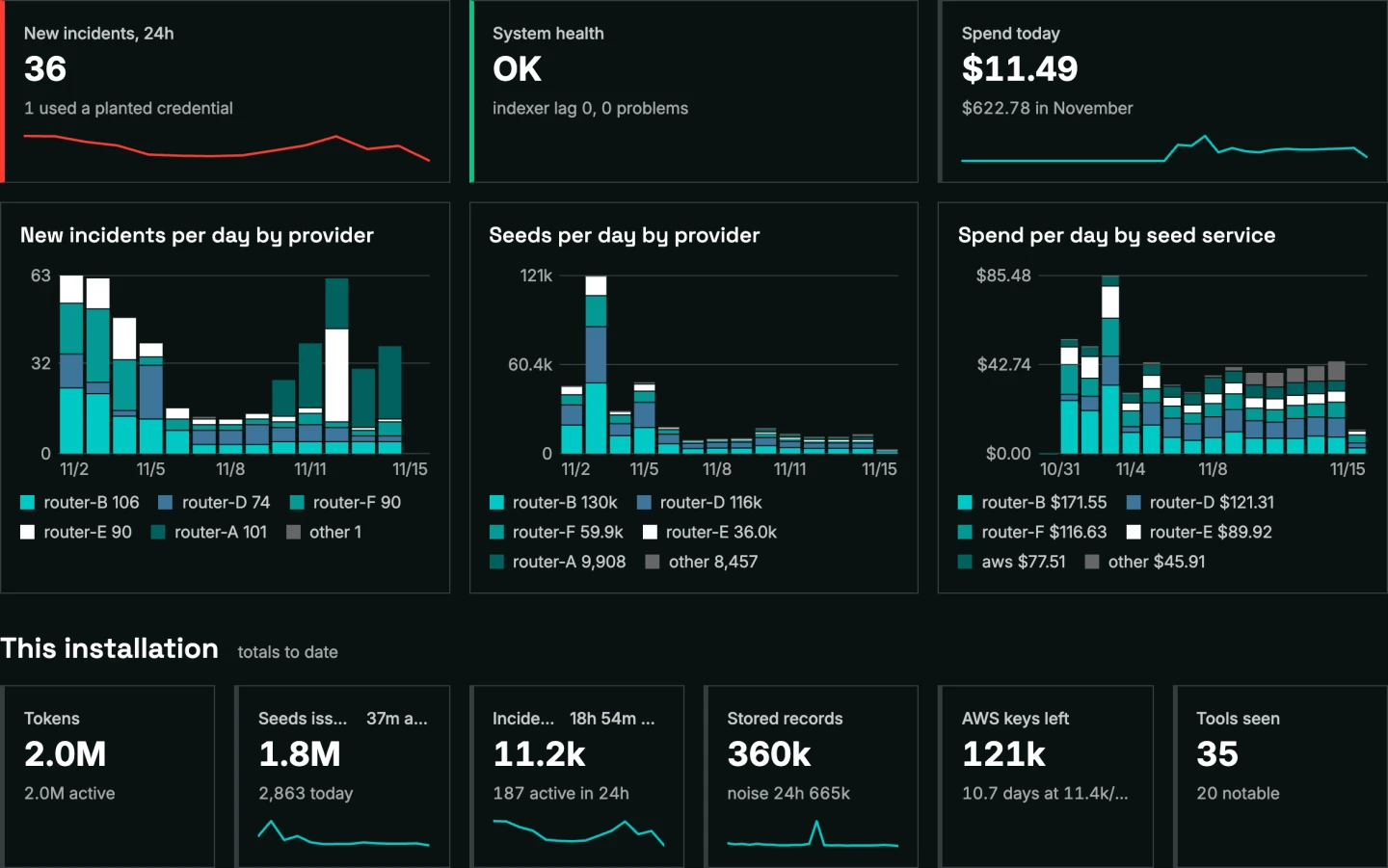
Figure 4: The Dragos Canary Token monitoring console, displaying daily prompt submission volumes and security events segmented by the router handling the requests.
Tracing AI Inference Chains via Request Fingerprinting
While Canary Tokens log access to decoy data, access records alone cannot pinpoint the exact stage where a leak occurred. To solve this, Dragos designed an AI inference path-tracing methodology analogous to network traceroute.
The first method identifies intermediate nodes via image URLs. Researchers embedded image URLs pointing to their own servers inside requests; whenever an intermediate system fetched the image, the server logged the source IP, HTTP client, and timestamp.
The second method analyzes nested error messages returned by routers. Researchers crafted slightly malformed requests. Because different routers wrap upstream error messages in their own formats, a single response could contain three to four layers of nested structures.
By matching these structures against a signature database, researchers inferred the intermediate nodes, software components, networks, and providers along the request path. As of the report’s publication, Dragos had traced approximately 2,000 AI inference routes, hundreds of which involved unidentified systems. Some requests traversed third-party nodes omitted from public routing documentation. Additionally, certain sellers injected roughly 1,000 hidden tokens into every prompt, while others fetched images through shared consumer subscription accounts.
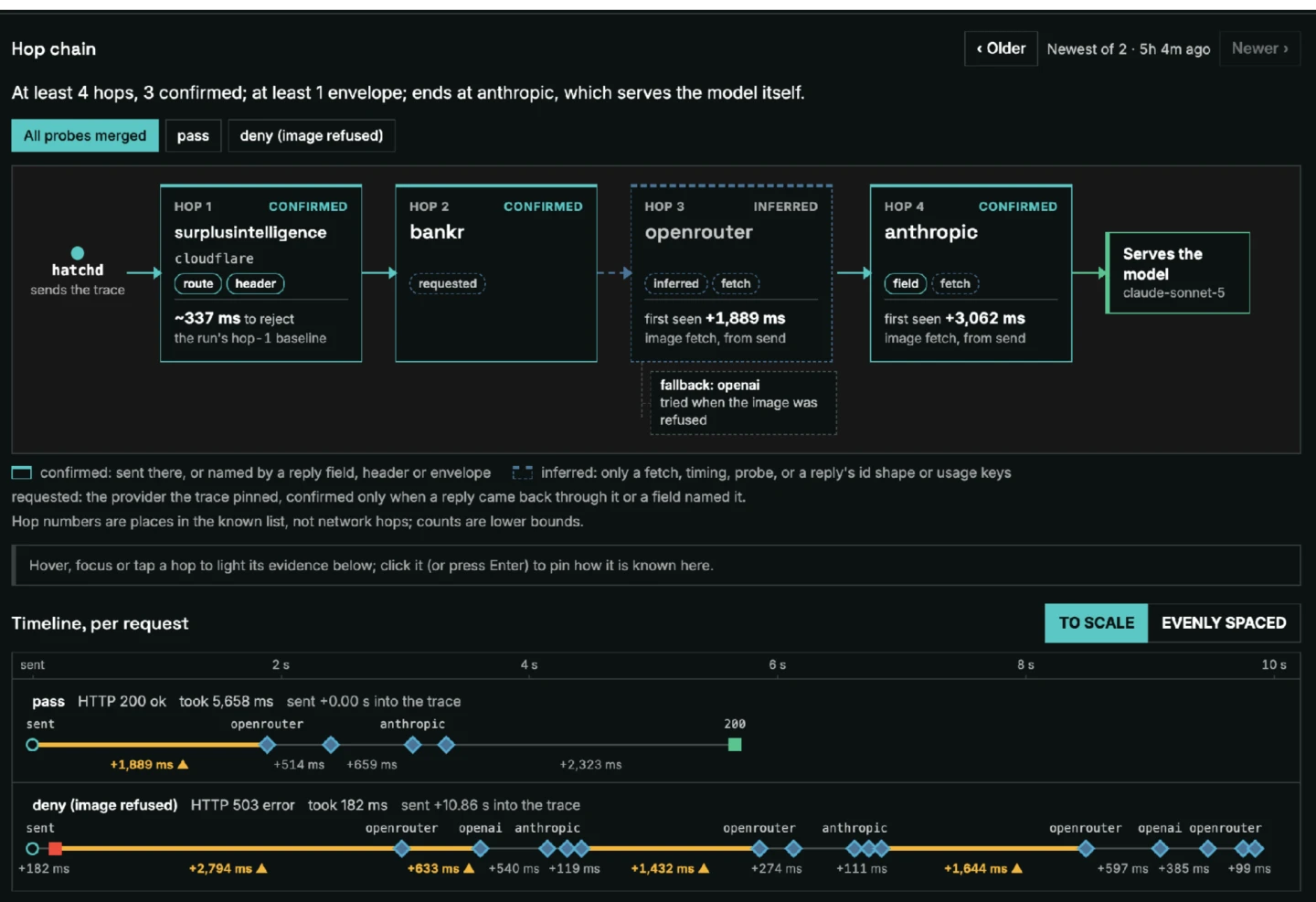
Figure 5: Example of AI inference route tracing. The diagram maps the request path from SurplusIntelligence to Anthropic, revealing an undisclosed OpenRouter intermediary node omitted from the marketplace listing.
Incident Response and Security Recommendations
Dragos shared the anomalous prompts, routing details, and access logs with affected providers for investigation. As of publication, Dragos had engaged with approximately 12 providers; several have launched internal investigations, and one router provider has halted the forwarding behavior in question.
To mitigate these risks, organizations should prioritize the following measures:
- Audit Router Configurations and Downstream Providers: Review router forwarding rules and downstream partners to verify which organizations actually process requests.
- Verify ZDR Enforcement: Validate Zero Data Retention settings and practices to ensure service logs, caches, and downstream providers are not retaining request payloads.
- Filter Sensitive Data: Detect and scrub API keys, cloud credentials, proprietary source code, and other sensitive information before sending requests.
- Assess Supply Chain Partners: Audit model hosts, API aggregators, and third-party sellers to evaluate their data handling, forwarding, and retention mechanisms.
Conclusion
By embedding unique decoys across nearly 2 million test prompts and monitoring subsequent access activity, Dragos uncovered provider breaches, unauthorized prompt harvesting via seller request logs, and failures in ZDR policy enforcement throughout the AI inference supply chain. Some prompts were still being accessed weeks after submission, while others were routed through downstream providers never disclosed to users.
This research introduces Canary Tokens into AI inference pipeline monitoring—combining decoy credentials, URL access logs, and request fingerprinting to trace how prompts traverse model-serving infrastructure, establishing a repeatable methodology for auditing AI service supply chains.
References
[1] Dragos, HD Moore: Three breaches, endless leaks: Your AI supply chain needs canaries
https://www.dragos.com/blog/ai-supply-chain-security-canary-tokens

