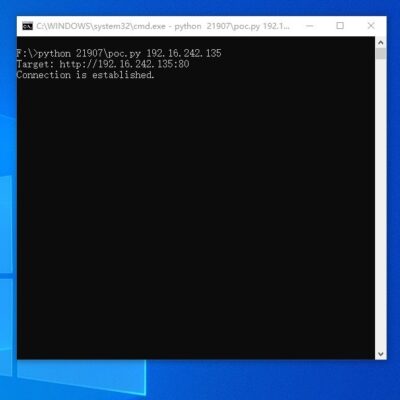
Overview Recently, NSFOCUS CERT found that a security researcher published details and the PoC of an arbitrary code execution vulnerability (CVE-2021-3490) in eBPF and exploited this vulnerability to cause local privilege escalation on Ubuntu 20.10 and 21.04. This vulnerability exists because the eBPF ALU32 bounds tracking for bitwise ops (AND,...
Blog
Cloud Native Security in Infrastructure Construction
Cloud native security is the development trend of cloud security in the coming years. On the one hand, inherent security of cloud native is worthy of in-depth study. On the other hand, with the reconstruction and upgrade of infrastructure, there is a clear trend towards the integration of cloud native technologies...
NSFOCUS Attends APEX CBET II
BEIJING. – Sep 14, 2021 The 2nd APEC Cross-Border E-Commerce Training (APEC CBET II) is held at 9:00am-11:30am (GMT+8) on September 8, 15 & 22, 2021 by the Department of International Trade and Economic Affairs of the Ministry of Commerce of China, supported by DHgate. This event is facilitated specifically...
Top Four Risks When Using Serverless Function in Cloud Native Applications
Serverless is a new computing mode of the cloud native architecture, mainly taking the form of function as a service (FaaS). For the serverless mode, developers will write a function and define when and how to invoke it and then the function will run in the server provided by the...
API Security in Cloud Native Applications
Cloud native applications, based on the microservice architecture, interact with each other by sending requests or response through APIs. Arguably, API communications play an essential role in interactions of cloud native applications. Therefore, API security is an indispensable part of cloud native application security. API-related security issues shown below have...
INFRAHALT: NicheStack TCP/IP Stack High-Risk Vulnerabilities Threat Alert
Overview Recently, researchers from JFrog and Forescout released a joint report to publicly disclose 14 security vulnerabilities (collectively referred to as INFRA:HALT) in the NicheStack TCP/IP stack, announcing that these vulnerabilities could lead to remote code execution, denial of service, information disclosure, TCP spoofing, or DNS cache poisoning. Researchers noted...