A Look into RSA 2019: Cultural Blending and Capability Building During the Implementation of DevSecOps

maio 24, 2019
As an increasing mature technical system in the security domain, DevSecOps, in nature, inherits the concept of shifting security to the left during the security development lifecycle (SDL). Simply speaking, DevSecOps is capability integration, continuous learning, and cultural blending. In fact, the concept of “blending” is also reflected by the theme of the DevSecOps Day at RSAC 2019, namely, “DevOps Connect”. The concept calls for CI/CD (continuous integration and continuous delivery and effective measurement to improve the efficiency.
Microsoft Remote Desktop Services Remote Code Execution Vulnerability (CVE-2019-0708) Threat Alert

maio 23, 2019
Overview
On May 14, 2019, local time, Microsoft released security updates for May that address a critical remote code execution vulnerability (CVE-2019-0708) in Remote Desktop Services. The Remote Desktop Protocol (RDP) is not affected by this vulnerability. As the vulnerability may be exploited in worm-related attacks, users are advised to download appropriate patches and upgrade their systems as soon as possible. (mais…)
NSFOCUS UNVEILS 7TBPS CLOUD DDOS WITH BIGGER CAPABILITIES AND BETTER MITIGATION TO PROACTIVELY PROTECT ORGANISATIONS FROM THE MOST DETERMINED THREAT ACTORS
maio 22, 2019
SINGAPORE, May 22, 2019 – NSFOCUS, the leader in holistic hybrid security solutions, today announced the launch of its 7Tbps Cloud Distributed Denial-of-Service (DDoS) Protection helps organisations to cope with the escalating frequency of DDoS attacks, regardless of their size, duration and complexity. The NSFOCUS Cloud DPS caters to gaming providers, internet service providers, and […]
2018 DDoS Attack Landscape-7

maio 22, 2019
3.5 Analysis of IoT Attack Sources
3.5.1 Participation of IoT Devices in DDoS Attacks
According to NSFOCUS’s IoT threat intelligence, some DDoS attacks are associated with IoT devices. By further analyzing the proportion of IoT devices in DDoS attack source IP addresses, we find that 3.14% are IoT devices. Although this proportion is relatively small, compared to the large base of DDoS attack source IP addresses, the threat of IoT device-based DDoS attacks cannot be overlooked.
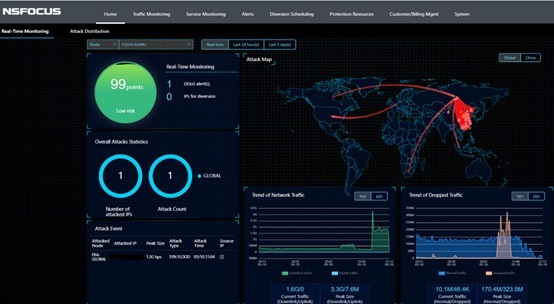
A Retrospective Analysis of 300G DDoS Mitigation Powered by NSFOCUS Cloud DPS
maio 21, 2019
The NSFOCUS multi-terabit DDoS protection was designed specifically to help enterprises regain control and build confidence with its vigorous layered protections against sophisticated attacks. With automation as an integral part of the NSFOCUS solution, DDoS attacks are detected and remediated immediately, with no disruption to services. (mais…)
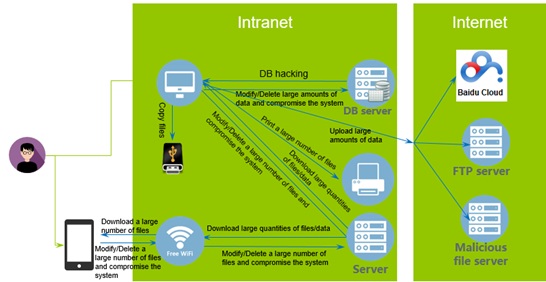
Machine Learning Algorithms Power Security Threat Reasoning and Analysis
maio 21, 2019
RSA Conference 2019, an annual infosec event that brings all cybersecurity professionals together, kicked off in San Francisco, USA on March 4, 2019. This year’s Conference took “Better” as its theme, which reflected infosec players’ visions to constantly improve their own capabilities and work out better security solutions. (mais…)
Practices of China’s Internet Giants in Machine Learning

maio 20, 2019
At RSA Conference 2019, Tao Zhou, a senior staff algorithm engineer from Alibaba Security, Alibaba Group, as one of only a few Chinese speakers, started his presentation on application of statistical learning to intrusion detection in the context of massive big data with an account of challenges facing Internet giants in security data analysis, and […]
Cisco Elastic Services Controller REST API Authentication Bypass Vulnerability Threat Alert

maio 17, 2019
Overview
Cisco has released a security advisory, announcing the existence of a REST API authentication bypass vulnerability (CVE-2019-1867) in Cisco Elastic Services Controller (ESC). This vulnerability is due to improper validation of API requests. An attacker could exploit this vulnerability by sending a crafted request to the REST API. A successful exploit could allow an unauthenticated, remote attacker to execute arbitrary actions through the REST API with administrative privileges on an affected system. (mais…)
Microsoft’s Security Patches for May Fix 82 Security Vulnerabilities Threat Alert

maio 16, 2019
Overview
Microsoft released May 2019 security patches on Tuesday that fix 82 vulnerabilities ranging from simple spoofing attacks to remote code execution in various products, including .NET Core, .NET Framework, Adobe Flash Player, Azure, Internet Explorer, Kerberos, Microsoft Browsers, Microsoft Dynamics, Microsoft Edge, Microsoft Graphics Component, Microsoft JET Database Engine, Microsoft Office, Microsoft Office SharePoint, Microsoft Scripting Engine, Microsoft Windows, NuGet, Servicing Stack Updates, Skype for Android, SQL Server, Team Foundation Server, Windows DHCP Server, Windows Diagnostic Hub, Windows Kernel, Windows NDIS, and Windows RDP. (mais…)
2018 DDoS Attack Landscape-6
maio 15, 2019
3.4 Behavioral Analysis of Attack Sources
In the 2018 H1 Cybersecurity Insights8, we mentioned that the number of DDoS recidivists (repeat DDoS offenders) was too large to ignore. Of all internet attack types, 25% of attackers were recidivists responsible for 40% of all attack events. As for DDoS attacks, 7% of attackers were recidivists that launched 12% of attack events. (Here, “DDoS recidivists” refer to source IP addresses that have been marked by NSFOCUS Threat Intelligence center (NTI) as DDoS attack sources.) Clearly, in DDoS attacks, the proportion of recidivists decreased in 2018, indicating a lower level of resource reuse. This can be attributed to two factors: (mais…)