Recently, NSFOCUS Security Labs captured a new APT34 phishing attack. During the campaign, APT34 attackers disguised as a marketing services company called GGMS launched attacks against enterprise targets and released a variant of SideTwist Trojan to achieve long-term control of the victim host. Introduction to APT34 APT34, also known as...

Ano: 2023
Introduction to ADS’s HTTP Keyword Checking Policy
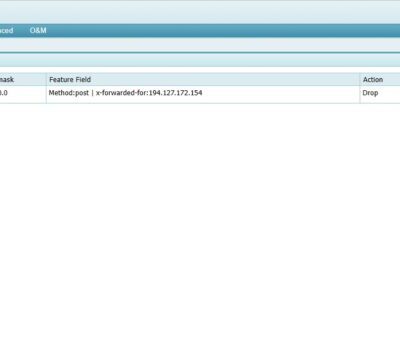
HTTP Keyword Checking is a process by which ADS controls HTTP traffic through the ADS device. In addition, ADS takes a specific action (Accept, Drop, Disconnect, Add to blacklist, Add to whitelist, or Limit rate) as configured on passing packets whose source IP address and specific fields match the HTTP...
Mastering Defense and Understanding Offense: Approach of Detecting Abnormal Attack Behaviors
In offensive and defensive exercises, attackers will use various attack methods to maximize their objectives, including not only common attack methods but also complex attacks. Phishing email is popular among attackers as the most commonly used and low-cost attack method. Attackers typically use a variety of techniques and deception to...
Workshop – Empowering Your Organization with Cybersecurity
Empowering Your Organization with Cybersecurity, Aug 17, 2023, Thailand. NSFOCUS Thailand team joined the partner event organized by Ingram Micro, introducing our product portfolio. With the increasing threats of #cyberattacks, more and more organizations recognized the need to implement a robust and reliable solution to protect the network from disruption.
Path Traversal Attack Protection
A path traversal attack, or directory traversal, aims to access files and directories stored outside the web root folder. When the server does not check the user input strictly, by manipulating variables that reference files with "dot-dot-slash (../)" sequences and its variations or by using absolute file paths, it may...
From Ripples to Waves: The Swift Evolution of the “Boat” Botnet
The botnet family “Boat†was first discovered by NSFOCUS Security Labs in June 2022. Its name comes from the fact that malicious samples in its early versions propagate with the file name "boat". At the same time, since some malicious samples in later versions of this family retain symbolic information...